Iran develops domestic 3D bioprinters for tissue repair
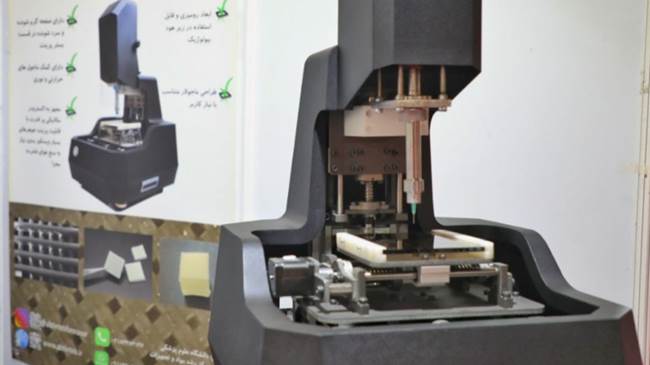
Iranian knowledge-based company Abtin Fanavvar has successfully developed domestic extrusion-based 3D bioprinters, enabling the production of precise and personalized implants for repairing bone and tissue defects within the country.
According to Mahmoud Azami, Professor of Tissue Engineering at Tehran University of Medical Sciences and CEO of Abtin Fanavvar, the printer, showcased at the Iran-Saakht (Iran-Made) Exhibition, falls under additive manufacturing devices and is specifically an extrusion-based 3D bioprinter.
Azami explained that the technology is designed for replacing lost tissues such as bone, skin, and cartilage. Its key advantage lies in personalized medicine, allowing implants to match the exact geometry and nature of each patient’s injury.
Traditional implants often have fixed shapes that may not fit irregular defects caused by accidents or tumor removal, whereas this 3D printer enables surgeons to produce implants tailored precisely to the damaged area, significantly improving treatment outcomes.
The printer also allows internal structure customization, including pores and channels, which support mechanical compatibility with body tissues and encourage natural tissue integration over time, a fundamental goal of tissue engineering.
Azami highlighted that previously patient-specific 3D models had to be sent abroad for production.
With the domestic printer, the entire design-to-production process can now be completed in Iran, reducing costs and eliminating the need for foreign outsourcing.