Iranian youth are shaping the country’s future through robotics and artificial intelligence
Afshin visits RoboCup 2026 qualifiers:
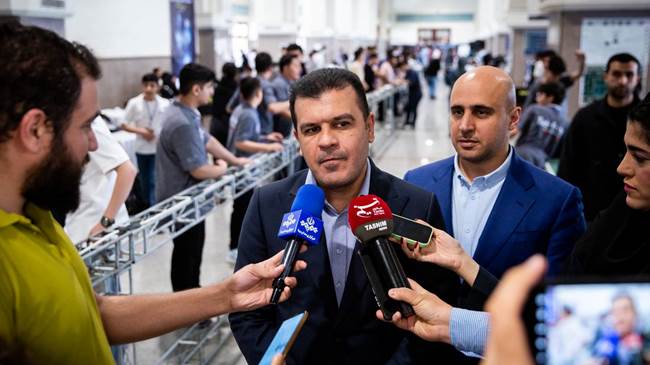
On the sidelines of the RoboCup 2026 qualifiers, Hossein Afshin, Deputy President for Science, Technology and Knowledge-Based Economy, emphasized the importance of the role of teenagers and young people active in the field of robotics and artificial intelligence in building the country’s future and announced the return of the national artificial intelligence platform to the service circuit by the beginning of June.
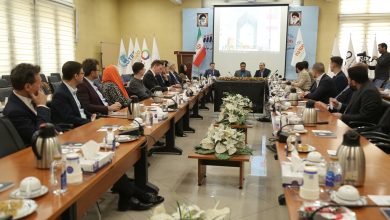
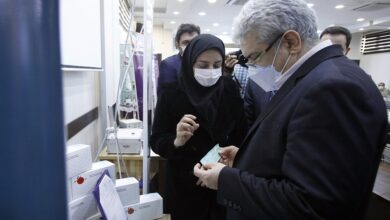
According to the Communication and Information Center of the Presidential Vice-President for Science, Technology and Knowledge-Based Economy, Hossein Afshin, Deputy President for Science, Technology and Knowledge-Based Economy, this morning, May 14, attended the RoboCup 2026 qualifiers, which are being held with the support of the Presidential Vice-President for Science, Technology and Knowledge-Based Economy at the Imam Khomeini (RA) Shrine in Tehran, visited different parts of the event and talked with the participating teams.
On the sidelines of this visit, the Vice President for Science, referring to the high capacity of the country’s teenagers and young people in the field of emerging technologies, stated: “What we see in these competitions today is a combination of excitement, creativity, and hope for the future. The future of Iran is built from these engines, sensors, designs, programming, and technologies that the country’s teenagers and young people are working on seriously today.”
Referring to the continuous efforts of the participants in these competitions, he added: “Even in a situation where the country is facing special restrictions and conditions, these teenagers and young people have been working for the past six months with a focus on robotics and artificial intelligence, and this shows that the country’s new generation is seriously pursuing the future of Iranian technology.”
The head of the National Elite Foundation, stating that the winners of these competitions will be sent to the 2026 RoboCup World Competition in South Korea, said: “We hope that these teams will bring honor to the country as always, and we are sure that they have the necessary capabilities to shine in the international arena.”
Explaining the structure of these competitions, he stated: These competitions will be held in two parts; first, the part that is currently being held in May, and the other part that will be held in September and in the student and college categories. The current competitions are held only in the student section and for the age group of 14 to 18; teenagers who may be young but do great things.
Afshin continued: “The future of the world is based on robotics and artificial intelligence, and these competitions will be held in three parts: rescue robots, soccer robots, and demonstration robots.” In the demonstration section, teams will present different stories and concepts based on defined scenarios.
Emphasizing the support of the Vice President for Science for the selected teams, he noted: The top teams in these competitions will be sent to global competitions, and we have also provided special support for the first team so that they can benefit from the capacity of more capable coaches and update their equipment and facilities. Our effort has been to maintain educational justice among the various schools in the country in the preliminary stage, but for the selected teams, we will have a detailed plan for a strong presence in the global arena.
The Vice President for Science also announced the consideration of special prizes for the top teams and said: The first to third place teams in these competitions will receive prestigious prizes, and in addition, the winners of these competitions will also benefit from the National Foundation for Elites.
Explaining how these points are awarded, he clarified: I must emphasize that simply winning first place does not mean that a person is recognized as an elite. The National Foundation for Elites has a specific scoring system.
Referring to the mission of the Scientific Vice-Chancellor and the National Foundation for Elites in identifying and guiding top talents, he said: “One of our most important tasks is to identify elites from an early age and guide their talents. Today’s Iranian teenagers show that when it comes to technology, robotics, and artificial intelligence, these concepts are not just a dream for them, but are part of their intellectual and practical lives.”
He emphasized: “We are confident that the future of the country will be built by these young people and teenagers, and human capital is the greatest support for Iran’s scientific and technological development.”